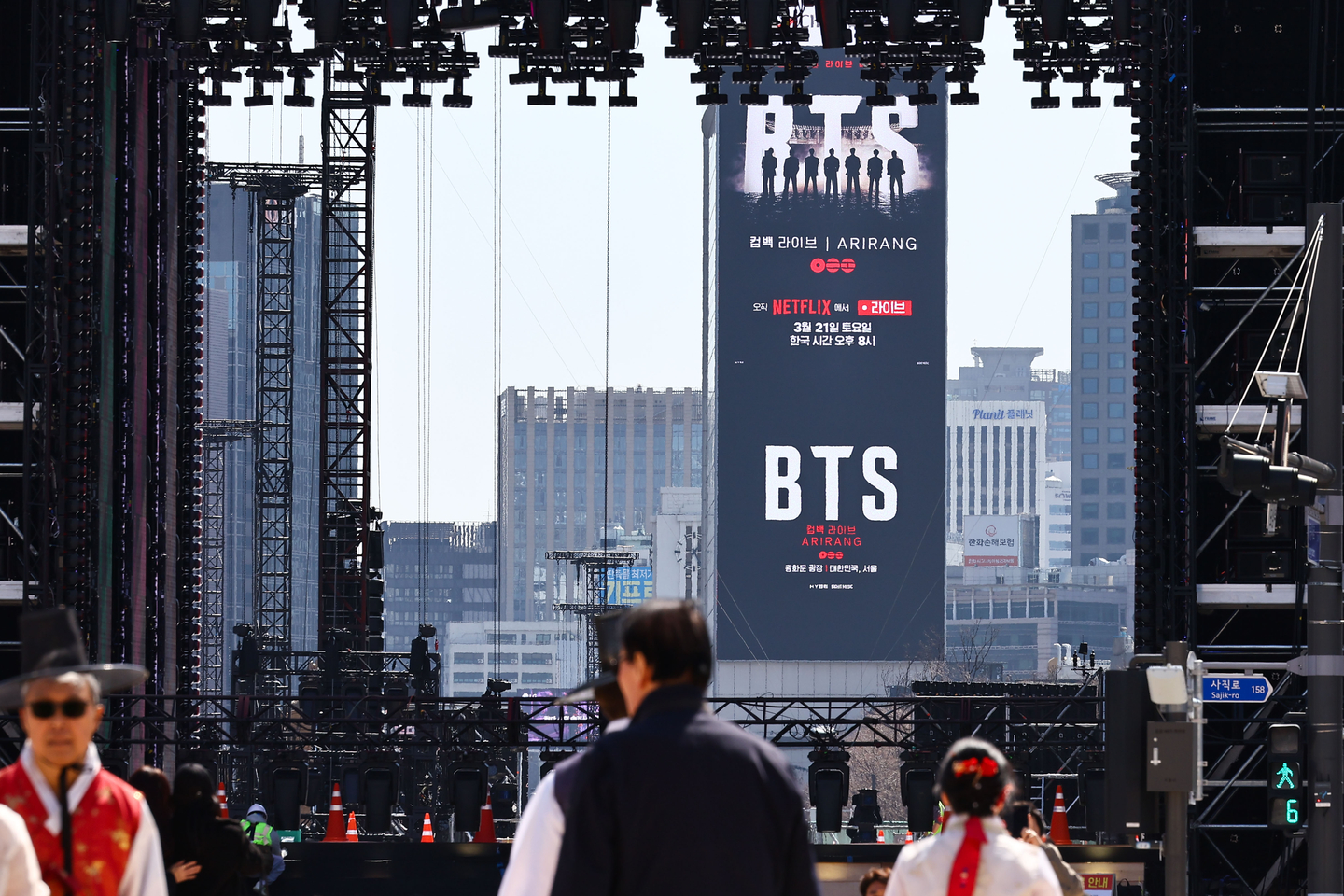
There’s a feeling that’s difficult to put into words when a new BTS song begins to play — as if time holds its breath for a moment, then rushes forward with more force than before. After 3 years and 9 months of waiting felt deeply by millions of fans worldwide, including hundreds of thousands of loyal Malaysian ARMYs, the iconic Seoul septet has finally returned as a complete unit. This comeback is far more than a music event — it’s a cultural moment that has left its mark simultaneously on the charts, streaming platforms, and global conversations.
But beneath the euphoria of the reception lies a far more intriguing layer of analysis. Korean netizens on the community platform Instiz have been dissecting the listener demographic data for BTS’s new release — breaking down exactly who is streaming it, from which age groups, and across which genders. The findings? A picture that has surprised many, and one that may well reshape how the K-pop industry understands the power of ARMY today.
The Numbers That Surprised Everyone: Far Beyond “Young Female Fandom”
For years, BTS — like most male K-pop groups — has been associated with a fanbase dominated by young women, particularly in the teens-to-early-twenties bracket. That stereotype isn’t without basis; it was precisely that demographic that propelled them to the top of the charts during the Blood Sweat & Tears and Dynamite era. But the listener demographic analysis of their new release, widely discussed on Instiz, reveals a landscape that is far more complex and considerably more mature.
Most striking is the notable increase in male listeners, alongside a significant presence of fans in the 25-to-35 age range — people who have quite literally grown up alongside BTS since the No More Dream days over a decade ago. These are no longer school kids screaming at laptop screens; they are young professionals, graduates, and even parents who have remained loyal companions on the seven Bangtan boys’ journey. This phenomenon reflects something genuinely rare in the world of K-pop: a fandom that has authentically aged alongside its artists, rather than simply being replaced by successive waves of new fans.
“BTS is no longer a teenage fandom phenomenon. They have become part of the cultural identity of a generation that is now helping lead the world.”
Three Years, Nine Months: How the Fanbase Evolved
Military service occupies a uniquely significant place in the K-pop context. Unlike a typical hiatus that tends to be filled with extended solo activities, mandatory military service means an artist genuinely disappears from the public radar — no livestreams, no comebacks, no direct fan interaction whatsoever. For ARMY, it was an unwritten loyalty test.
Yet it was precisely during that period that something remarkable happened: the BTS fandom remained active, and in several respects actually grew more mature and focused. Conversations within the global ARMY community shifted away from viral hype toward a deeper appreciation of BTS’s discography, lyrics, and artistry as a whole. Many fans used the hiatus to revisit older music, watch documentaries, or even take up Korean language classes — a trend reflected, incidentally, in the measurable uptick in Korean language course enrolments in Malaysia over the past few years.
What Korean Netizens Are Saying: The Instiz Debate
According to the discussions unfolding on Instiz — one of the most influential K-pop community platforms in Korea — the streaming figures and listener demographics for BTS’s new release have sparked heated debate. Some netizens argue that the increase in male listeners and the strong presence of mid-to-late twenties fans is concrete evidence that BTS has successfully transcended the “idol” label, graduating into the category of true artists respected across gender and age lines.
Others point out that this may simply reflect the natural evolution of BTS’s music itself — new material that is thematically richer and more layered, drawing in listeners who seek genuine lyrical depth and artistic expression rather than just an easy, infectious bop. The distinction matters: BTS haven’t reinvented themselves to chase a new demographic. Rather, a new demographic has found its way to them precisely because BTS has grown organically as artists.
For Malaysian ARMYs: More Than Just Being a Fan
In Malaysia, the ARMY community ranks among the most active and diverse in Southeast Asia. From Kuala Lumpur to Kota Kinabalu, from university students to professionals in the creative industries, BTS has touched lives across cultural backgrounds and communities. What’s interesting is that the demographic trend observed in Korea maps almost perfectly onto the local reality — Malaysian ARMYs who first discovered BTS during their secondary school years are now working adults, some already raising families, yet still carving out time to stream and follow the group’s every move.
This comeback moment has also opened up broader conversations — from family group chats to office pantries — about K-pop’s role in shaping the musical tastes and cultural identity of Malaysia’s current generation. For the local ARMY community, BTS’s new song isn’t simply another track added to a playlist; it’s a timestamp, an emotional bookmark connecting who they were then to who they are now.
A Signal for the Broader K-Pop Industry
The listener demographic analysis of BTS’s comeback actually carries implications that extend well beyond the group itself, touching the K-pop industry at large. For a long time, Korean entertainment companies have built their marketing strategies around the assumption that idol fandoms are inherently transient — that there will always be fresh fans to replace those who move on. BTS has demonstrated, convincingly, that this model doesn’t have to hold.
When fans remain committed across an entire decade, and when they bring with them considerably greater purchasing power as adults — buying albums, attending concerts, travelling to Korea specifically to experience a culture they love — the long-term value of a mature, loyal fandom far outstrips the flash-in-the-pan hype of a new fan wave. That’s a business and cultural lesson worth sitting with for everyone in the K-pop ecosystem, from agencies in Seoul to concert promoters right here in Kuala Lumpur.
BTS’s return after nearly four years is more than a music announcement — it is proof that genuine loyalty, when nurtured with integrity and sincerity, can outlast the test of time. And for Malaysian ARMYs who have waited with quiet patience, this moment feels a little like rediscovering an old favourite song — one that somehow sounds more meaningful now than it ever did before.